


Marking car parks with a robot: new layouts and repainting
By VerdaMachina · Last updated 16 Sep 2026 · 2 min read
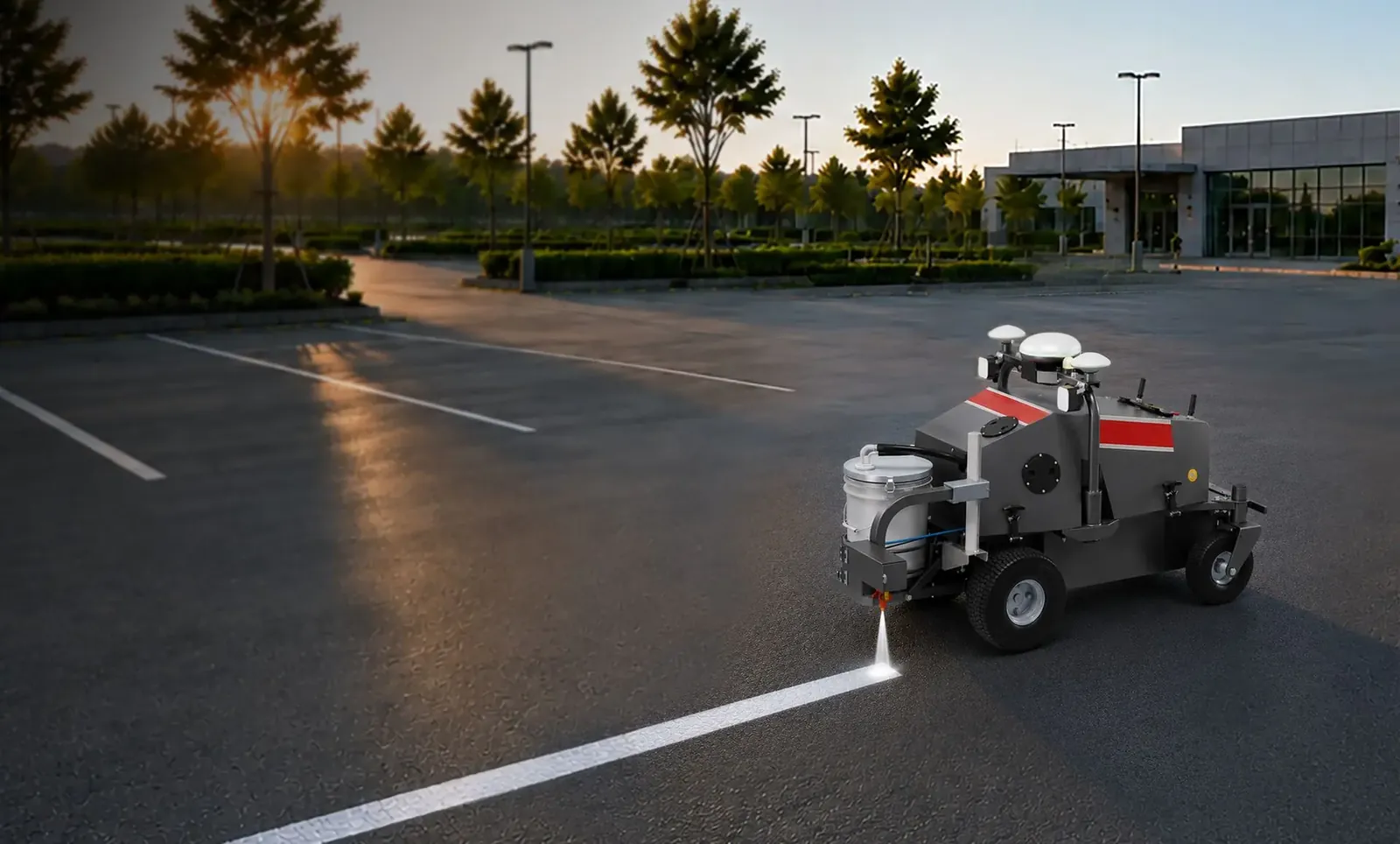
Markings on a car park or business park wear faster than you think. Lorries, forklifts and daily traffic dull the lines, and faded bays lead to sloppy parking, lost spaces and unsafe situations. Repainting today is usually done by a crew that sets out, masks and sprays, often at night or at weekends to avoid blocking the site. A line marking robot makes that work shorter and more predictable.
Two types of jobs
On paved surfaces there are two very different jobs. With a new layout, bays, lanes, arrows and pedestrian crossings must be applied according to plan, often on a new or resurfaced site. With repainting, existing lines must be followed exactly, even when they have half disappeared. The FJD PaintMaster Parking is made for both.
The digital workflow
The work does not start with a tape measure, but with a scan. The Trion S2 Max scanner captures the geometry of the site, together with existing lines, obstacles and the surface. In SiteMind the layout is built digitally: bays, arrows, lanes and safety zones. Before the robot starts, the route, spray sequence, turning space and obstacles are simulated. That way you see in advance whether everything fits, instead of afterwards.
When repainting, the robot uses AI vision to align itself with the existing line edges, centre lines, arrows, numbers and bay boundaries. As a result the new line stays on the old one, even when it has faded.
High pressure for asphalt and concrete
The PaintMaster Parking marks with a pressure of up to 20 MPa and a flow rate of up to 2 litres per minute, with a line width of 10 to 25 cm and a 19-litre paint tank. The 4 kWh battery is quickly swappable and lasts about 6 hours. According to FJD this requires up to 80% less labour and marking is up to 5 times faster, but the actual gain depends on the site, the layout and the way the crew works.
Who is this interesting for?
- Managers of business parks and logistics sites with many bays, loading zones and driving routes.
- Shopping centres and retail car parks where marking must be done quickly outside opening hours.
- Municipalities with public car parks and park-and-ride sites.
- Line marking companies and contractors who want to complete more projects with the same crew.
Safety on site
The robot has 360° real-time monitoring and physical collision protection. You follow status, progress and alerts in the app. On large sites several robots can work together in coordination. A cordoned-off work zone of course remains necessary, just as with manual line marking.
Also for airports
For runways, taxiways and aprons there is the FJD PaintMaster Airfield, which marks directly from approved CAD drawings and can therefore work within shorter closure windows. More on the airports page.
Do you manage a car park or business park? See the sector page car parks and business parks or request a proposal.
Frequently asked questions
Can a robot repaint faded parking lines? +
Yes. The FJD PaintMaster Parking uses AI vision to follow existing line edges, centre lines, arrows and bay boundaries, so the repainting lands on the old lines.
Which markings can the robot apply? +
Parking bays, arrows, aisles, no-parking zones and crossings. Special symbols or custom markings may require templates.
Does the car park have to be completely empty? +
The zone where the robot works must be clear and cordoned off. Because the robot works faster, this can usually be done in shorter blocks or outside opening hours.
Machines in this article
More insights.
Robotic mower for a football pitch: 7 questions before you choose
Area, cutting height, collection, slopes and service: the questions that decide which robotic mower suits your football pitches.
Read article
Line marking robot for sports fields: how to choose the right one
How a line marking robot works, what it saves and how to choose between a light club robot, a robot for several pitches and stadium precision.
Read article
Cylinder mower or rotary mower: which robot suits your turf?
The difference between a cylinder mower and a rotary mower, and which robot to choose for greens, fairways, football pitches or municipal green spaces.
Read articleReady for smarter grounds?
Request a free field audit or demo.